

Worried You Have Macular Degeneration? Early Symptoms, Progression, and What to Expect

Being told you have macular degeneration or worrying you might have can be frightening. Many people immediately wonder, “Am I going blind?” or “What will happen to my vision?” The good news is that macular degeneration does not usually cause complete blindness. Instead, it affects the macula, the part of the eye responsible for sharp central vision used for reading, recognizing faces, watching television, and seeing fine details. While some people experience only mild changes for many years, others notice more significant vision loss over time. Understanding what macular degeneration is, how it progresses, and what tools are available can help you take control and maintain your independence.
Understanding Macular Degeneration- simplified

Macular degeneration, often called age-related macular degeneration (AMD), is a common eye condition that affects the part of your eye responsible for sharp, detailed vision. This area, called the macula, helps you read, recognize faces, watch television, drive, and see fine details.
When macular degeneration damages the macula, the center of your vision may become blurry, distorted, or develop missing spots. You may still be able to see objects around you using your side (peripheral) vision, but tasks that require seeing details can become more difficult.
One of the biggest misconceptions about macular degeneration is that it causes total blindness. In reality, most people keep their peripheral vision. However, central vision loss can still have a significant impact on everyday activities such as reading a menu, recognizing a friend’s face, or watching your favorite television program.
Macular degeneration is one of the leading causes of vision loss in adults over age 50. While there is currently no cure, early detection, proper medical care, and the right low vision aids can help many people maintain their independence and continue enjoying the activities they love.
What Macular Degeneration Might look like
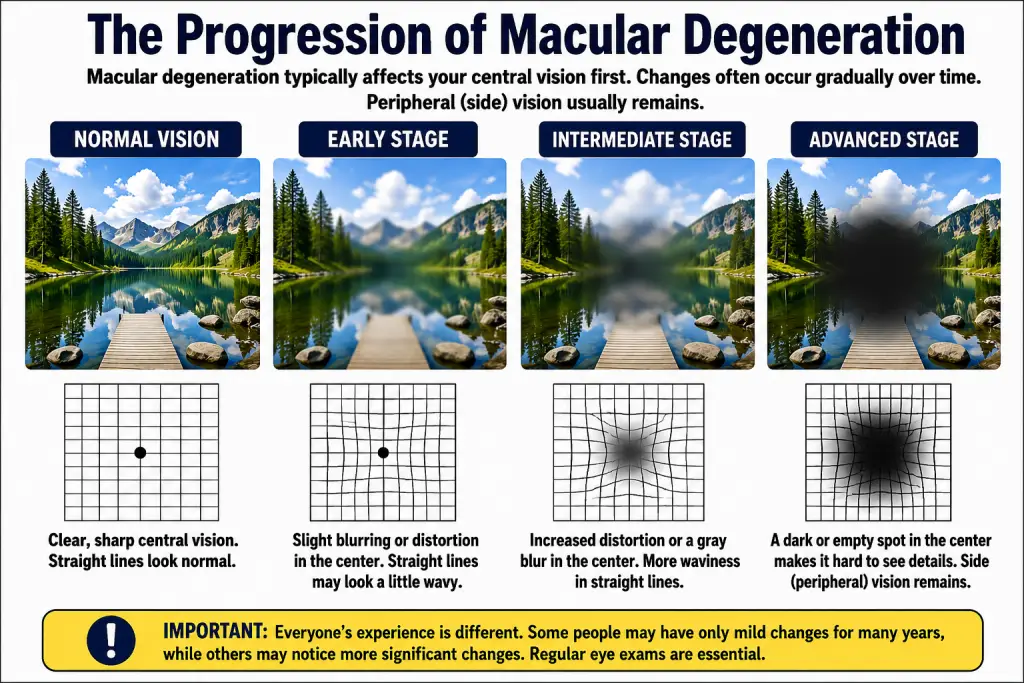
What Macular Degeneration Might Look Like
One of the most confusing things about macular degeneration is that it doesn’t affect everyone the same way. Some people notice only mild blurring in the center of their vision, while others experience distortion, missing spots, or more significant central vision loss over time. In the early stages, straight lines may appear slightly wavy, and fine details may not seem as sharp as they once were. As the condition progresses, the center of vision may become increasingly blurred or distorted, making it more difficult to read, recognize faces, watch television, or perform tasks that require seeing fine details.
The illustration on the left shows a simplified example of how age-related macular degeneration (AMD) may progress. While some people experience only mild changes for many years, others may notice more significant vision loss. It’s important to remember that not everyone follows the same path, and many people never develop severe central vision loss. Regular eye exams and early treatment can play an important role in helping preserve vision and maintain independence.
What are early symptoms of Macular Degeneration
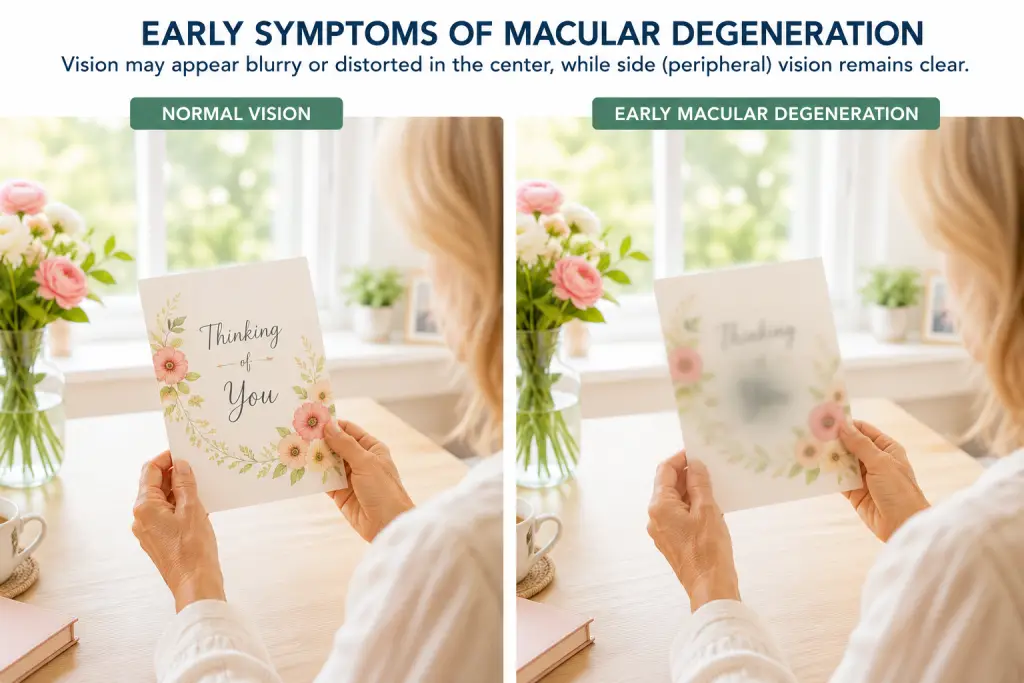
In the early stages of macular degeneration, many people don’t notice any symptoms at all. Others may begin to experience subtle changes in their central vision that are easy to dismiss as normal aging. You may find that words aren’t quite as sharp as they used to be, faces seem slightly less clear, or straight lines appear a little wavy or distorted.
Unlike advanced macular degeneration, early-stage AMD does not usually cause a large dark spot in the center of your vision. Instead, the center may appear mildly blurry, distorted, or less detailed than before. Some people describe it as looking through a smudge on a window or feeling like they can’t quite bring an object into focus, even when wearing their glasses.
Because these changes often happen gradually, they can be difficult to notice at first. Many people are surprised to learn they have macular degeneration during a routine eye exam before significant vision loss occurs. That’s why regular eye exams are so important, especially for adults over age 50.
Can Macular Degeneration be Treated?
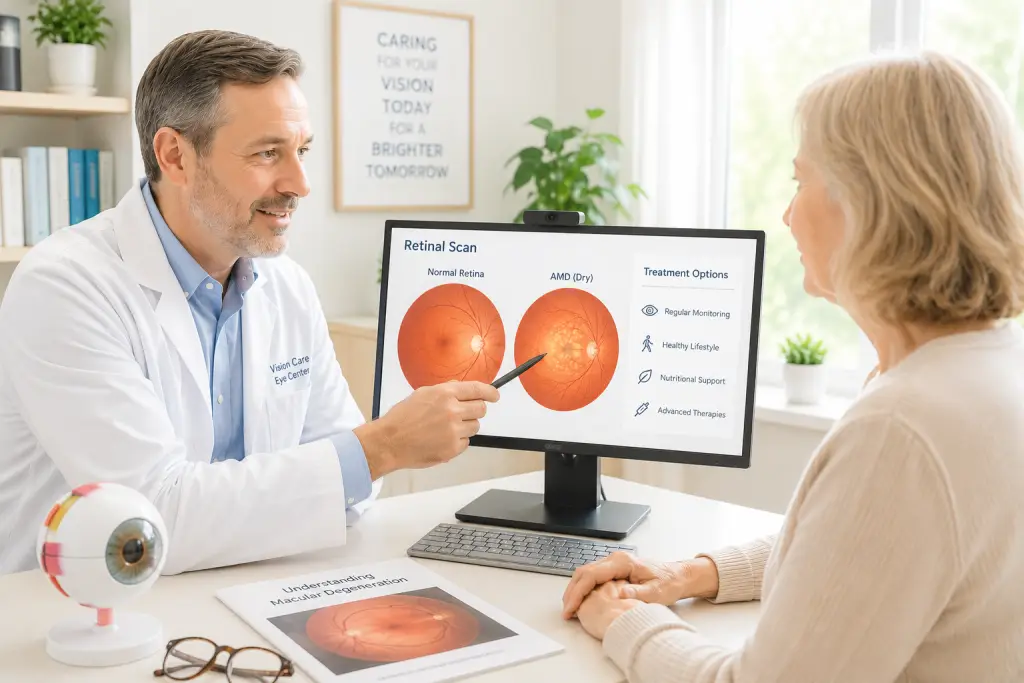
One of the first questions people ask after being diagnosed with macular degeneration is whether it can be cured. Currently, there is no cure for age-related macular degeneration (AMD), but there are treatments that may help slow its progression and preserve vision.
For people with wet macular degeneration, eye doctors may recommend medications that are injected into the eye to help reduce abnormal blood vessel growth and protect vision. For dry macular degeneration, treatment often focuses on monitoring the condition, managing risk factors, and in some cases using specific nutritional supplements recommended by an eye care professional.
The most important thing to remember is that many people with macular degeneration continue to live active, independent lives for years after diagnosis. Early detection, regular eye exams, and the right vision aids can make a significant difference in maintaining quality of life.
Helpful Products for macular degeneration